Breastfeeding Anxiety – (Yeah, it’s a real thing, and it has a name)

“You’ll be fine mama, this is normal. Every mother does it.”

“Don’t stress about it. That will affect your milk supply! Just be calm.”

“If you don’t breastfeed, you will never bond with your baby. Just push through, don’t give up.”

“If you use formula, you might as well be poisoning your baby.”

These kindly (and not so kindly) meant words are so encouraging, right? Mmm no.

Breastfeeding is a beautiful and fascinating aspect of motherhood. The body’s ability to produce a life-sustaining substance with more nutrients and benefits than one could even imagine possible seems like a fool proof activity. However, this is the ideal situation and it’s just not the case with every mother. Unfortunate as it is, there is a wide range of reasons why breastfeeding may actually not the best the best option for you and your baby.

Some moms have won the fight against breast cancer but have had to adjust to life without breasts. Some have had to deal with insufficient glandular tissue or hormone issues that cause their breasts to produce no milk. Yet others have had to deal with the silent pain of a condition called D-MER. My heart goes out to every woman who finds herself in one (or many) of these situations. But absolutely nothing could break the bond of love between these mothers and their children. Bonds that were formed, not by breastfeeding, but by love, caring, holding, talking, singing, cleaning and protecting their babies.

One of the conditions that a new mother might find herself experiencing is one I mentioned above – D-MER. I had never heard of this until recently but to know that what I experienced was a real disorder and not because I failed at being a mother has brought much comfort to me, and may do the same for you.

What is D-MER?

D-MER or Dysphoric Milk Ejection Reflex is a spectrum type disorder so what it looks like for you will probably be different to that of another mom. D-MER is a dysfunction in the mechanism that allows breast milk to flow and can cause negative emotions for anywhere from 30 seconds to two minutes at milk letdown, according to Alia Macrina Heise, IBCLC, CLE, CPD, a lactation consultant in Naples, New York, who is credited with pioneering research on D-MER. This field of study has only been around for about 10 years, though, so there is not a lot of information about it, other than than the experiences of mothers dealing with this rare condition.

I am still continuing to learn much about this but from what I can deduce, this is not a psychological disorder like post-partum depression or other anxiety disorders but a physiological disorder. When breastfeeding, dopamine levels drop in order for prolactin levels to rise and create the milk ” let down”. If there is too steep of a drop in dopamine, this can triggers feelings ranging anywhere from mild anxiety and irritability to major panic, anger and paranoia among other things.

By absolutely no fault of their own, some mothers suffer from the frustrating and difficult to potentially debilitating problem while breastfeeding – most of the time being told that it is totally normal.

There is an endless amount of information we could learn about the human body and scientists have barely scratched the surface. Now, more than ever, we should be compassionate and understanding. We may not know what a new mom is dealing with. She may not even know.

Be loving, patient, supportive and understanding. She really needs it.

My Experience.

Right before the nurse checked his blood sugar.

While I’m fascinated with the complexity of D-MER, I don’t know for sure that I had this condition or just hit the perfect storm of unfortunate circumstances that made breastfeeding impossible, but I can certainly relate.

Parker was born with very low blood sugar. Before we could even attempt a successful feed, he needed glucose syrup and a bottle of formula. I had no milk yet and he was five minutes from being taken to the NICU. There was no other option. Due to the quick action from the pediatric nurse, Parker’s blood sugar slowly began to rise to a safe and healthy level. He was no longer lethargic and I was no longer panicking. Without that formula and intervention, my story would have a very different ending.

However, with that came a very lazy eater. Coupled with his overbite and my low milk production. Well, you can guess. What followed was two months of lactation consultant appointments, crying, sleepless nights, more crying and ultimately, hefty breastfeeding anxiety. Every time I felt milk come in, I also felt scared. My nipples were black and blue, my baby was hungry and I was losing my joy.

At this point I realized that it was way more important for my baby to eat and for him to have a mom that was happy and rested than for me to fulfill this unrealistic understanding that I could only be a good mom if I exclusively breastfed. That was bogus. Formula was plan B, but without it, I would not have my baby or my sanity.

Attempting to feed. He had a terrible latch and the pain was excruciating.

Whatever your circumstances, please know that when you do your personal best within the realm of your own limitations and prioritize your baby’s health and happiness along with your own health and happiness, both physical and mental, you are a good mom. The first year is not easy. Everything is new and tough and crazy. But it ends and before you know it, you’re kid is almost three and telling you “Mom, you bought the wrong Kombucha! I like the blue one.”

We’re just fine.

My Birth Story – Parker David

“Whenever and however you give birth, your experience will impact your emotions, your mind, your body and your spirit for the rest of your life.” – Ina May Gaskin

These words carry a very special truth known by mothers all over the world. Giving birth will impact you for the good or for the bad. I truly believe that whether you give birth at home, in a birthing center, a hospital or out in the woods, it can be a wonderful experience. For me, the key to this was knowing myself and my needs (as much as any first time mom can know) and planning well for them.

My personal experience was in a hospital with an OB/GYN and an amazing nursing staff. This environment was just what I needed to feel comfortable and cared for. I was in labor for thirty-six hours.

Thirty. Six. Hours.

With each eight hour shift change, came a new labor and delivery nurse. I owe every one of those women a debt of gratitude. They made the difference between a positive experience, and a dreadful one. I am so incredibly grateful to have had such a wonderful team. But I’m getting ahead of myself. Let me start at my forty week check up.

Full Term

As a blissfully ignorant mom-to-be, I was sure that I would not make it a day past forty weeks. Parker had been sitting low in my pelvis and I had been dilated to one centimeter for some time. I was positive it would be any day now. As I sat there waiting for my doctor to arrive, I was trying to comfort myself with the knowledge that I would soon see my sweet little baby and this never ending cycle of doctors would soon be over. I did not anticipate the long road that lay ahead of me.

As I saw forty-one weeks closing in on me, I felt that I could not mentally and emotionally handle being pregnant for one more day let alone another week. I chose to schedule an induction at forty-one weeks and one day. Pregnancy was an amazing time, but it came with its difficulties as well. Knowing that there was an end in sight brought me great relief. All the planning was done, bags were packed and preparations made. Now I could focus all my attention on my one and only job. Birthing this baby.

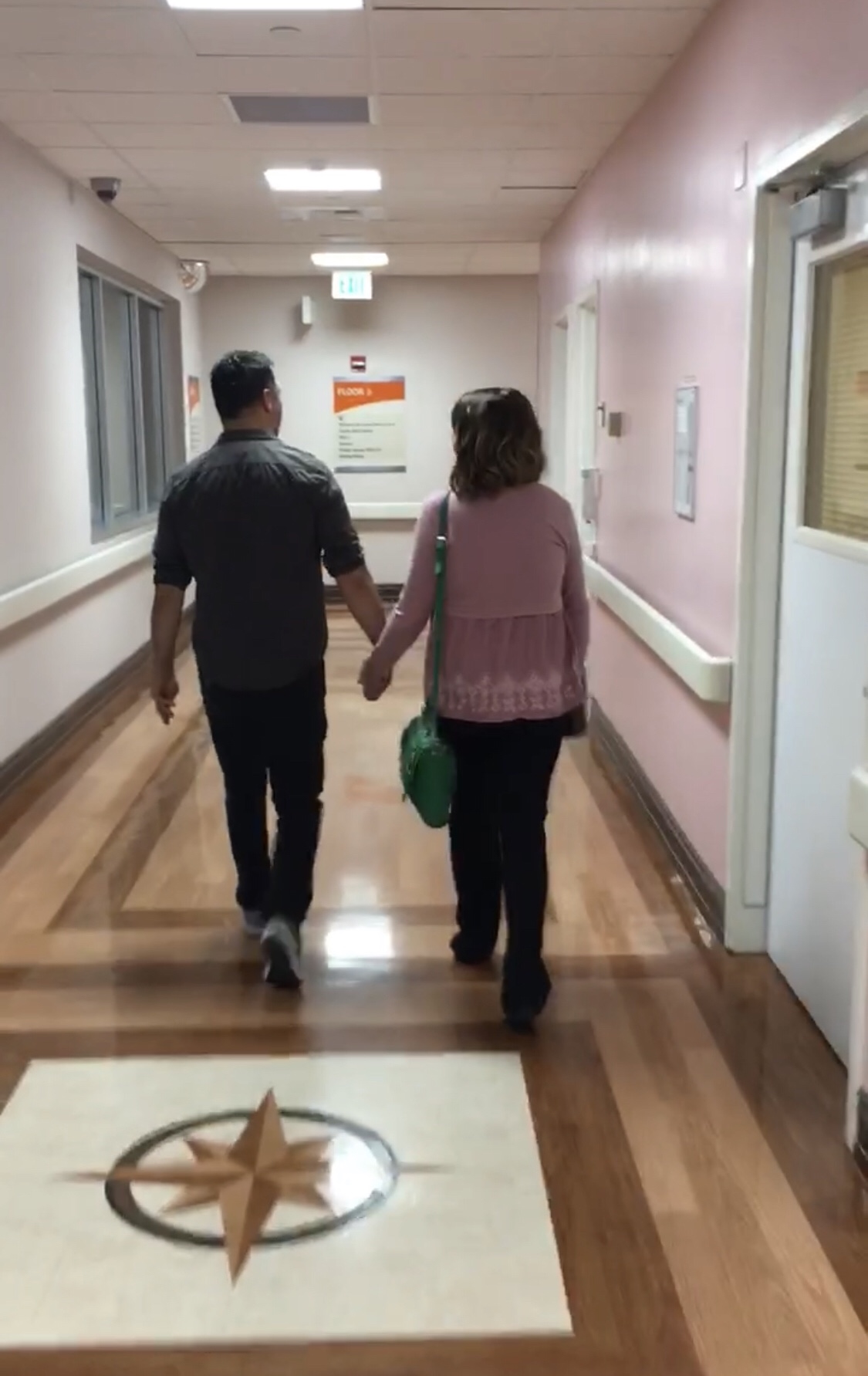
On Friday October 27, 2018 at 7:00pm, we made our last walk as a childless couple.

Little did we know, we would not meet Parker for two more days.

Being Induced

Oh boy, what a process this is. I will try to be as concise as possible. First thing after all the papers are in order and they lead you to your Labor and Delivery room, you will undress and put on that oh-so-lovely hospital gown. I couldn’t help but be reminded of a hilarious (and appropriate) comedy bit by Jim Gaffigan. “Perhaps this is a gown someone died in yesterday…” I thought to myself.

Next, you get your IV. Ugh! The dreaded IV. I should mention that I have Vasovagel Syncope which means, as google says: “A sudden drop in heart rate and blood pressure leading to fainting, often in reaction to a stressful trigger.” So it might sounds silly, but the IV was one of the scariest parts for me. My nurse was amazing and really knew her stuff, so this went without a hitch. Whew!

Soon after, I took the first of three doses of Cytotec. This is a drug used to prevent ulcers in those who take NSAIDs on the regular. They have found that it is helpful in inducing labor, so we started with this.

After several hours without effect, I was then proscribed Pitocin. This slowly began my labor. What took place over the next twenty-eight or so hours is a bit of a blur, honestly. Exhaustion had set in. I had constant adjustments to the baby monitor, several rounds of heavy (and painful) antibiotics via IV, multiple (and more painful!) cervix checks and, mercifully, an epidural.

These were the trying aspects of labor. They were just a blip on the radar, however, compared to the overwhelming relief and joy I felt as I saw my son’s face for the first time. At 9:19am on October 29, 2018, surrounded by loving family and friends, Parker was born! He was absolutely perfect.

I couldn’t believe it! After nine months, I wasn’t pregnant anymore. But now I was a mom! A MOM!

Ina May was indeed correct when she said giving birth would change my life forever, and I was so happy.

Stay tuned for my post-birth recovery blog next week!

Sarah Goes to Jury Duty

It’s a normal day in late April, I arrive home from a long day of work, tired and hungry and blissfully unaware of what awaited me on the kitchen table. I waltz in the house not even thinking there might be mail for me, as I walk down the hall I hear a voice trailing from the living room. “There’s something for you on the table, and you’re NOT going to like it”. My heart falls through my bowels. I turn and walk back to the kitchen. There it is, a 5×7 notecard, emblazoned in red letters “YOU HAVE BEEN SUMMONED”. Nooooo! The day I’ve dreaded for years. I had successfully avoided this moment 6 years in a row, now my number was up. I quickly got on the court website to see about disqualifying myself. No joy. (For you modern Mommie’s out there, you can automatically postpone service if you are breastfeeding, and may be excused if you are the only one who can care for your children.) There was nothing I could do. This was it, now all I could do was try to live normally for the next 2 weeks, and work to ignore the cloud looming overhead, jurydutiousonimbus. Looking back, it actually rained every day I had to be at the courthouse, odd for May in my hometown. It was like the universe was crying for me.

The day before I had to appear, I scoured the internet for tips. This helped me immensely, so I thought I’d add my testimony *wink wink* to the pile, in hopes that it will assist the many more souls desperately searching for refuge on the uncharted sea of jury duty.

Here’s what you should know:

Before you leave the house-

Pack a reusable water bottle and snacks if you aren’t a fan of vending machine fare. Be sure to bring distractions, a book, a smart phone, a tablet, sudoku, something, anything to stave off boredom while waiting around. Bring tissue, or as in my case, a wad of toilet paper just in case of snot. Hand sanitizer and lip balm are also a good idea. Also be sure to bring your summons. This is how you will gain access to the jury room.

Now that you are ready to go-

1. Be a little early to make sure you have time to get a good parking spot and walk to the courthouse. And go to the bathroom before check-in. And have enough time to go through security. So if proceedings start at 9 get there by at least 8:40. Don’t make everyone wait around for you, because things can’t get started until everyone is there.

2. Going through security. It’s less invasive than TSA but there are still metal detectors and gray bins. Leave everything in your bag, even large electronics, and only remove shoes if told to do so. They are only screening for weapons so feel free to walk through with your latte and full water bottle.

3. Follow the directions of the jury coordinators and check-in. Then just wait….. until further instructions are given.

4. After the initial orientation, one of the coordinators will start reading the potential jurors names off in alphabetical order. Pray your name isn’t called. If it isn’t you will be excused and will not have to return. If it is….

5. You will then be led into the courtroom for voir dire (the question and answer part). You will stand and be sworn in. Like to secrecy regarding all details you are about to hear regarding the trial. The judge will explain the charges against the defendant and introduce all court staff. The court clerk will call the names of all you potential jurors, this time at random. If and when your name is called, you and all the other fortunate souls will get in the jury box and answer questions about any hardship you may have or possible bias you might be harboring. This takes forever so be prepared. Be honest in your answers. Don’t try to make up a bias or hardship because you will be called out on it. But if you do have a genuine reason to be excused, speak up. They want you to be forthright, but do everyone a favor and keep your answers relevant to the case at hand. This is a long process so don’t make it any longer than necessary. For example, one young potential juror, when asked if anyone had ever previously been in a courtroom, went in to a several minute anecdote about the one time he almost had to attend court, but in the end never actually went. There are 7 minutes none of us will ever get back, and for what? An answer to a question that wasn’t even asked. So for the love of all that is right and pure, be reasonable when deciding what to say. When everyone has answered the judge and attorney’s questions. The attorney’s will dismiss any jurors they think are not right for the case. Then the process starts anew until all 12 spots and 1-3 alternate spots are filled. In my jury experience it took a day and a half to make the complete jury. Ugh.

6. By now hopefully you have been dismissed. If not, you will now be experiencing the trial. Either as one of the 12 or as an alternate. I was selected as alternate juror #1. As an alternate juror you must sit with the jury throughout the course of the trial listening and making notes etc. just like a regular juror, however you do not deliberate on a verdict with the 12 unless one of them is incapacitated in some way. When they are excused for deliberations, you are excused from court and put on call until a verdict is reached. Being on call means you promise to be reachable by phone and within about 30min of the courthouse on days and times the court is in session until a verdict is reached. Again, just in case one of the 12 jurors is incapable of continuing deliberations. I was never called to fill in on deliberations, so I unfortunately have no tips on how to survive that. As an alternate, when a verdict is reached you will be contacted with the option of attending court to hear it, or be told over the phone. After that happens, all jurors are excused from service and you can now live your life like a normal person.

What I learned from jury duty:

First off, while very inconvenient, jury duty is not as scary as I imagined it would be. Yes, as an introvert, answering questions in front of a courtroom full of people was intimidating. However, the judge and attorneys are actually quite nice and everyone else has to be quiet, so it was actually pretty ok. Secondly, there are specific instructions for everything so don’t worry that you won’t know what to do. You will be told how to conduct yourself and how to do your job ad nauseam, to borrow a lawyer’s phrase. Thirdly, details of the case can be graphic. So depending on the nature of the charges be prepared for things to get real. The case I was assigned to was not of a disturbing nature, however I did find myself crying during a witness testimony, due to the utterly depressing state of the individuals life, and had to quickly compose myself. This is real life, not a tv show, (the only previous experience I had of a courtroom) so just be ready for that. I’m a sensitive person by nature so that may have had something to do with the tears. If this isn’t something you’re comfortable with speak up in voir dire. Lastly, I learned how much I didn’t actually know about the legal system. While I wouldn’t go so far as to say it was an “enriching experience”, as the juror instructional videos would have you believe, it was interesting and enlightening.

All in all, jury duty is fine. It’s not that it’s enjoyable, but it’s not terrible either. The worst part is the time suck that is involved and sometimes the nature of the trial. While your jury experience might not be exactly like mine, I hope that what I went through can help prepare you for this little slice of life we all get served *wink again* sooner or later.

sarahslibrary.video.blog